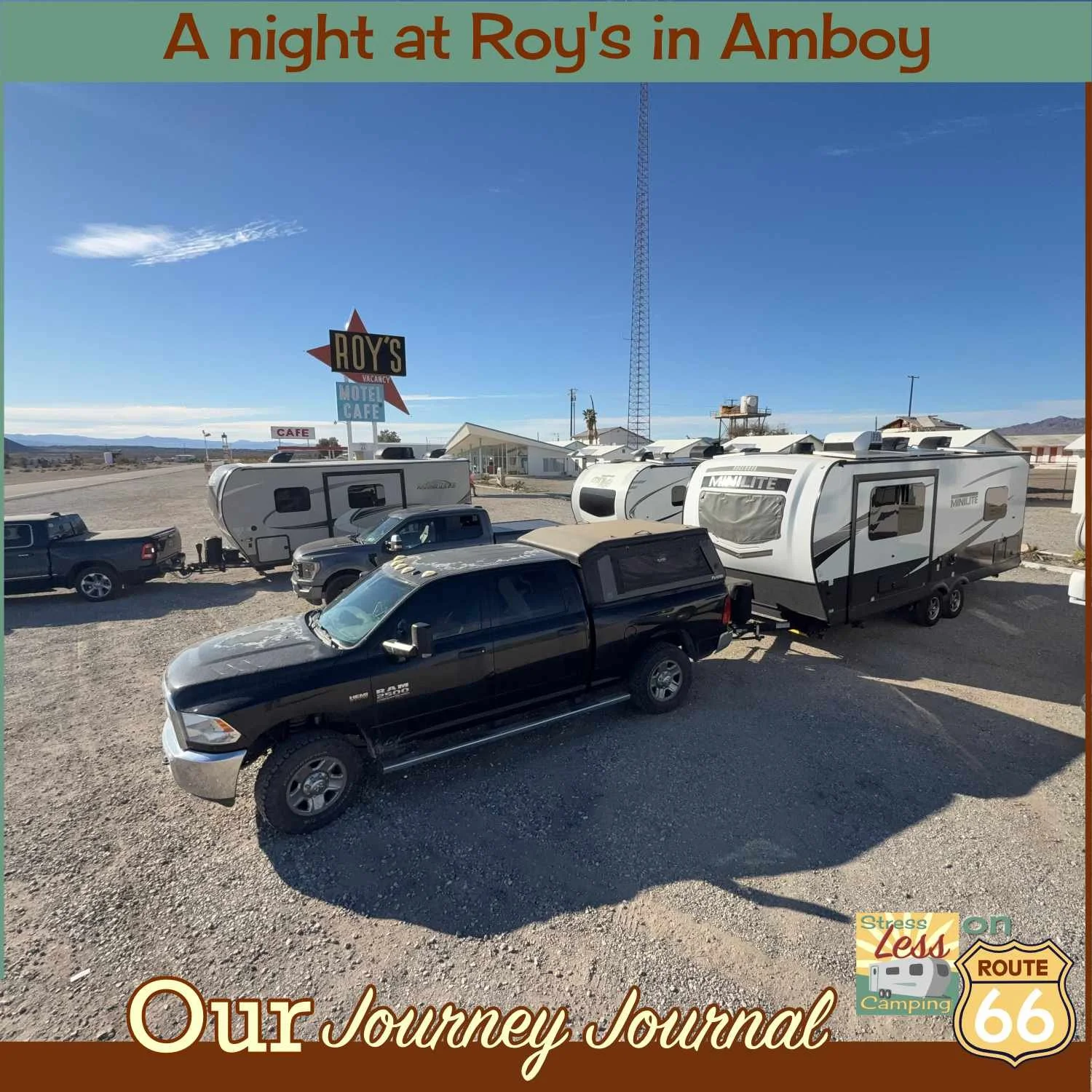
Spending the night at Roy's in Amboy on Route 66
One of the most photographed and iconic signs on Route 66 is Roy’s in Amboy, California. With it’s optimistic arrows that epitomize Googie architecture the sign inviting you to stop at Roy’s must have been a beacon of hope for a lot of adventurers on Route 66 at a time when cars were less reliable than they are now and the desert heat was complicit in radiators steaming their displeasure at the desert sun.
Like so many other relics of Route 66’s past, Roy’s Cafe isn’t a cafe, Roy’s motel isn’t a motel and a lot of the town surrounding Roy’s isn’t even there any longer. But you should absolutely stop.
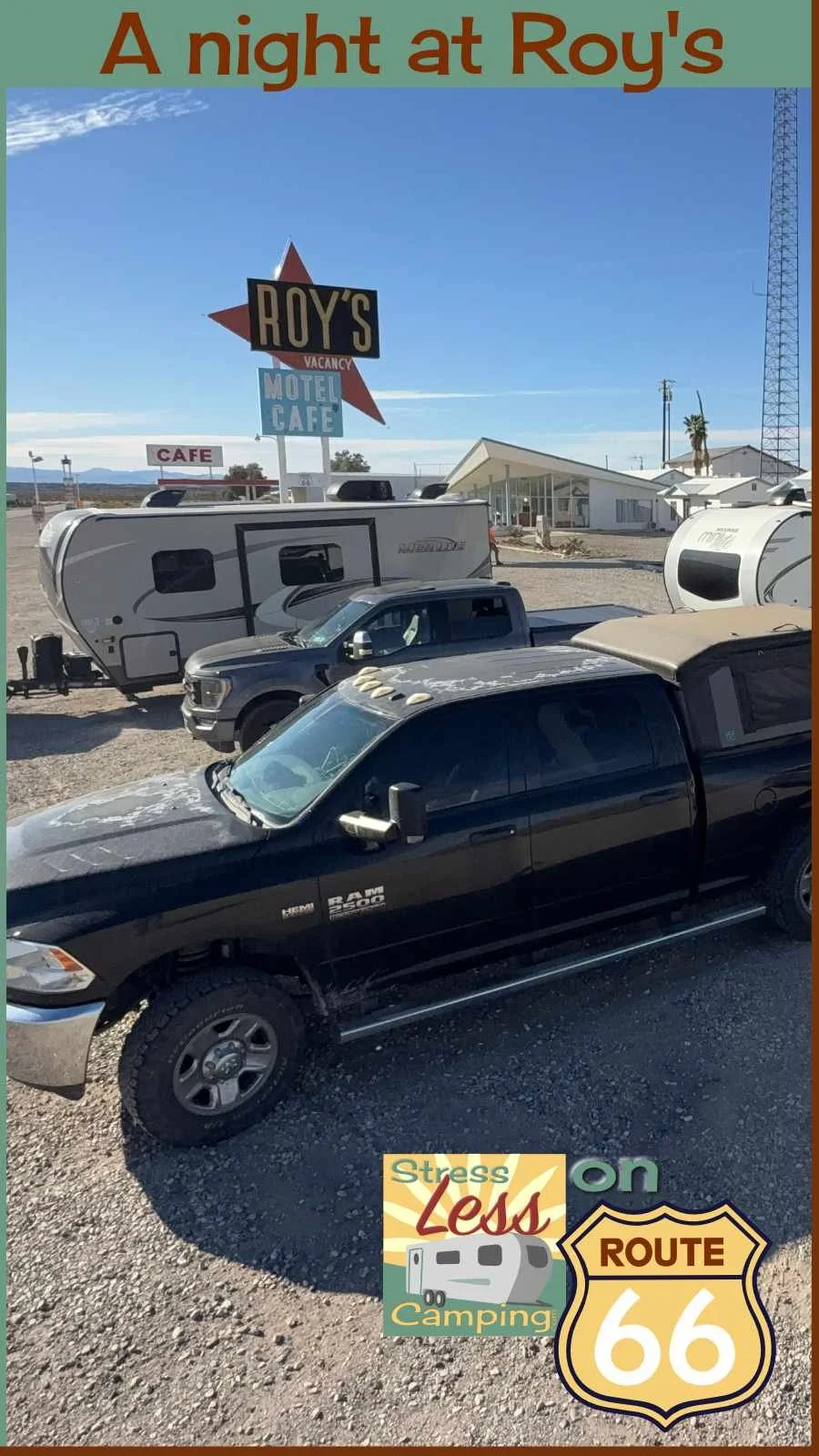
History of Roy’s in Amboy
According to Wikipedia Roy Crowl opened Roy's as a gas and service station in 1938 along U.S. Highway 66 in Amboy. The construction of Roy's was one consequence of the highway's 1931 realignment through Mountain Springs Summit, which made the road bypass Goffs, California to directly connect Needles and Essex and continue west to Amboy.
In the 1940s, Crowl teamed up with his son-in-law, Herman “Buster” Burris. They expanded the business to include a café, an auto repair garage, and an auto court of small cabins for overnight rental by Route 66 travelers. Buster Burris himself created the town's infrastructure almost single-handedly, some of which remains semi-functioning now. Burris also brought power to Amboy and Roy's from Barstow by erecting his own poles and wires alongside Route 66, using an old Studebaker pickup.
Postwar business was profitable, as customers traveled with cars after the WWII era of tire and gas rationing and new cars not being manufactured. During that time, Roy Crowl and Burris kept Roy's Garage and Café operating constantly; as a result, Burris posted classified advertisements in newspapers across the country to recruit people to help.
By the beginning of the 1950s, Roy's complex employed up to 70 people; the town's entire population then was 700.
Some aesthetic changes came to Roy's Motel and Café in 1959, such as the February 1 erection of the famous neon sign, which was visible for miles for those approaching Amboy; as well as the construction of the motel's new Mid-Century modern guest reception area, which was described as appearing similar to an "inclined roof flying over a glassed wedge," and its office-themed building style.
Roy’s in Amboy today
This is the second place we’ve been to on Route 66 that has been made better by Albert Ocura, founder of the Juan Pollo chain of fast food restaurants. You see Ocura bought the entire town, all 950 acres of it, from Bessie Burris.
We got to speak with the town’s manager, Ken Large, who described the challenge of bringing things up to code including the electricity which was still in place from the way Buster Burris ran it ostensibly without permits.
The goal is to even get the cafe back up and running as well as opening several of the cottages but one of the challenges of this is that the town’s water is brackish at best. Today’s regulations don’t permit serving hauled water for human consumption. It used to be that the railroad would haul water in but that isn’t happening any longer either, what with steam engines being relics of the past.
Large also got the vintage mechanical gas pumps to work again and, surprisingly, there was a relatively steady business for gas at the station despite being $6.49 per gallon. Wow. But it’s not easy keeping these old pumps running and Large described having to scavenge parts from other parts - sometimes people even offer parts from pumps they have.
The entire interior of these is mechanical so changing prices is no easy task - you have to go in and alter the gearing to accommodate the change. Most modern gas pumps can be changed remotely from the cashier stand at the station.



You can stay at Roy’s in Amboy
One of the places I was most excited to stay at was Roy’s in Amboy but not in the cabins. Roy’s is one of the many reasons we love being members of Harvest Hosts as you can stay in the town and we did. There is plenty of space for a lot of RVs so our three Mini Lite trailers still left plenty of space for others.
This is another reason we also love our solar and lithium system from ABC Upfitters. No power problems on these overnight stays.
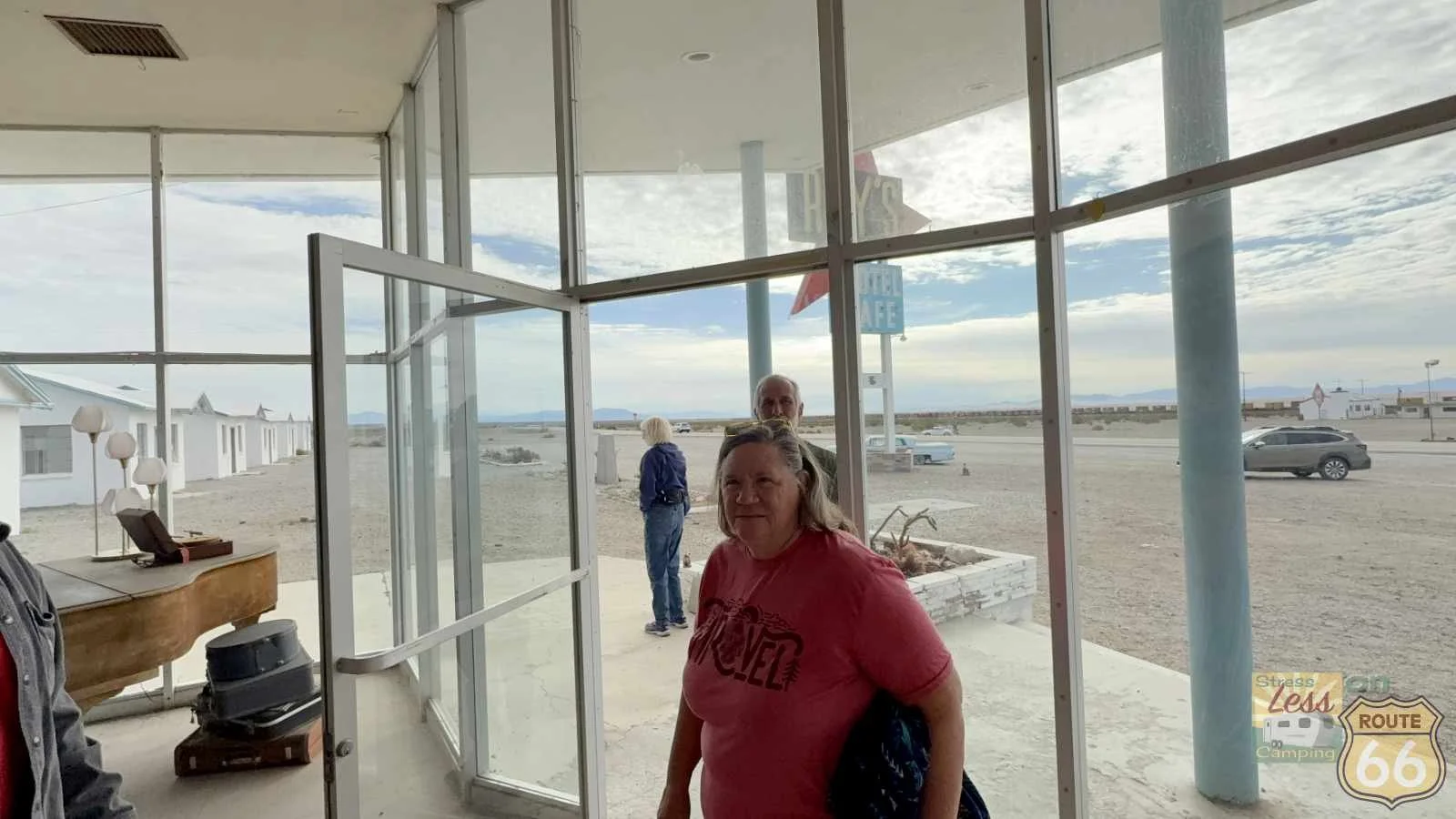
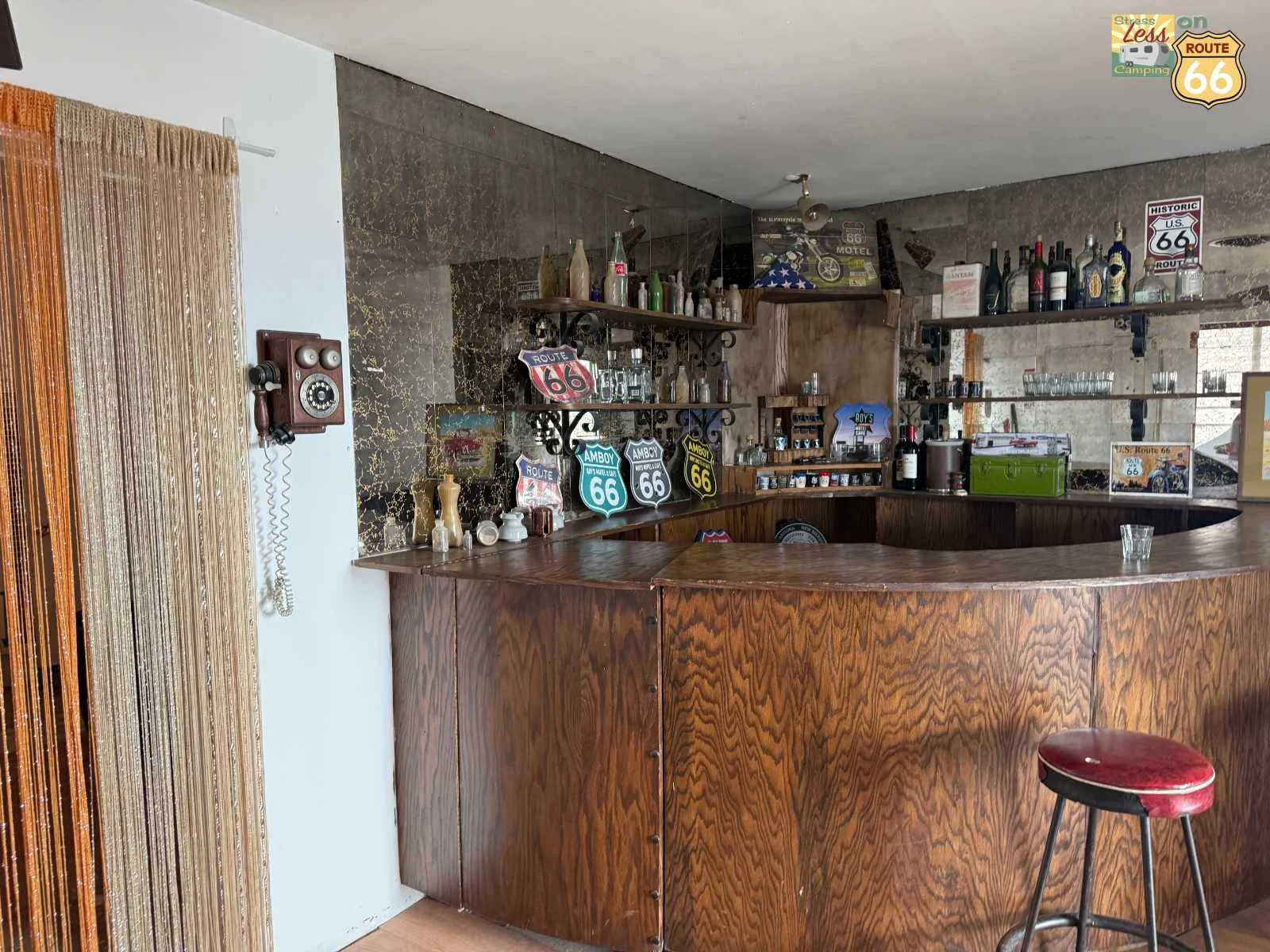
Of course we visited the gift shop but Large also gave us a tour of the Googie lobby at Roy’s where he revealed that there’s a secret bar behind the curtain. They don’t serve customers and most people don’t get to get into the bar but we did. Large, who spent years as a contractor, described one of the challenges of Googie-inspired buildings being that no two corners are square - the idea is no complete right angles.
“That’s still not easy for me to process as a former contractor.”
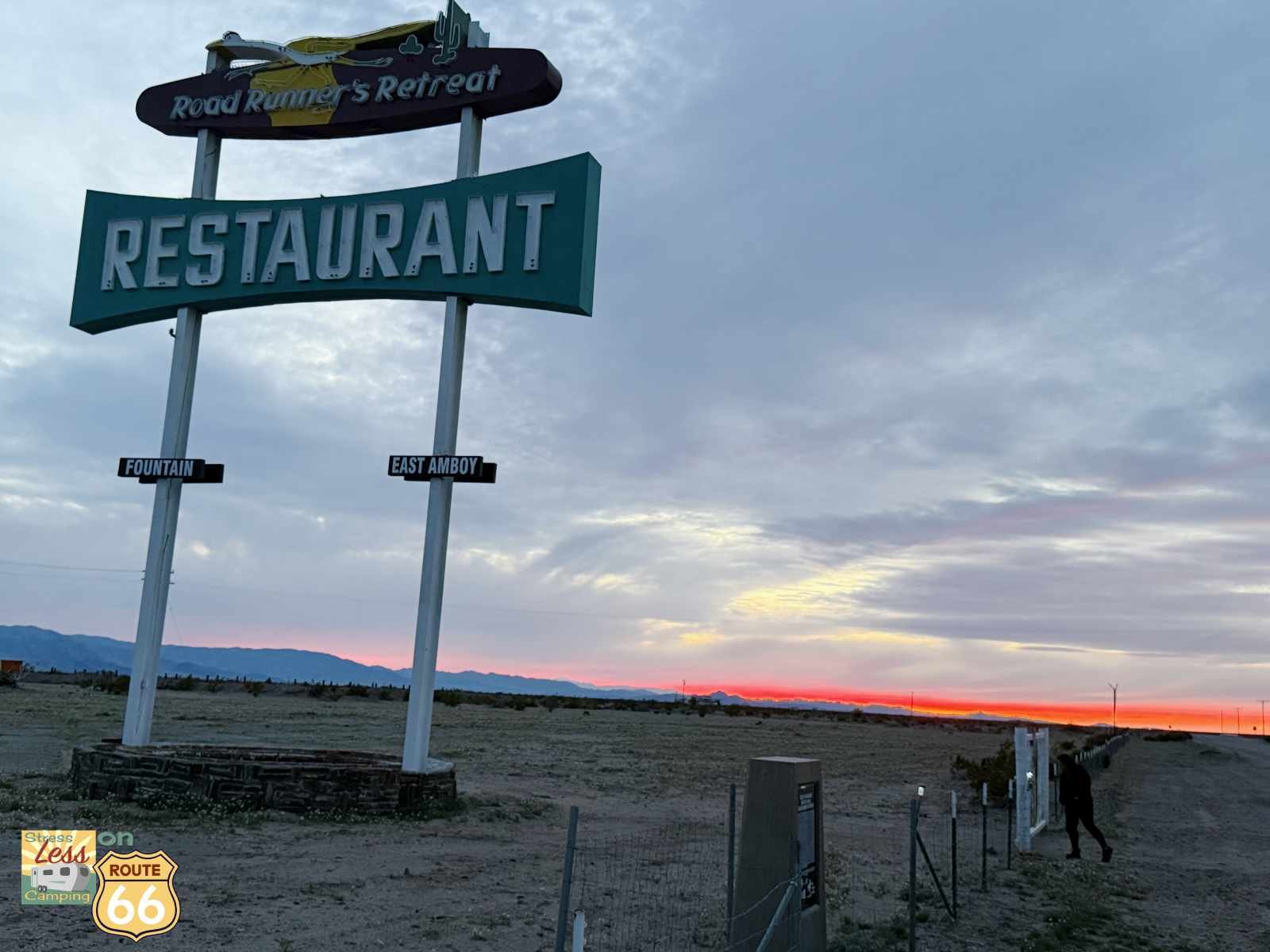

Road Runner’s Retreat
From Chicago to Santa Monica Route 66 was dotted with roadside cafes and gas stations. These stops provided a respite for those traveling the mother road, offering a refreshing soft drink, a burger and fries, or an eye-popping cup of coffee as well as a tank of gas. Between Amboy to the west and Chambless to the east stood the Road Runner's Retreat with its iconic neon sign. The upswept canopy over the gas pumps was in the style of Googie architecture - an architectural movement heavily influenced by the space age, jet aircraft, and the car culture. road runner's retreat was somewhat of a latecomer to Route 66
Roadrunner’s Retreat was built in 1962 by Roy Tull and his wife Helen. Shortly after opening, the retreat was purchased by “Duke" Dotson and his wife, Virginia. They and their children moved into a mobile home behind the restaurant and gas station and began serving customers. The Dotson kids attended school at Amboy and, later, Needles. During the sixties many of the Dotson's employees were itinerant.
Traveling along Route 66, a husband and wife team would phone ahead to Road Runner's Retreat asking about employment. Upon arriving, the husband might work as a cook or in the gas station, while the wife waited tables. After a few weeks or months, they would move on, to be replaced by other wanderers of the west. Duke Dotson also started a towing service, and was given the Auto Club contract for the area. The tow trucks were built on site, and Duke boasted that he and his crew could fix anything. Road Runner's Retreat and the Dotsons served thousands of travelers until Interstate 40 was opened in 1973.
According to Duke's son, Duke Junior, the opening of I-40 was ”like shutting off a faucet” on Route 66: the day before the interstate opened, traffic was heavy on Route 66. The next day, there was no one.
Like many other Route 66 gas stations, cafes, and attractions, Road Runner's Retreat closed shortly thereafter. The Dotsons sold the property to the Murphy family. The restaurant burned down in 2020; however the Murphy family has plans for the site.
This text comes from the sign at the facility which is one of many, many signs erected by the Billy Holcomb chapter of the Ancient and Honorable Order of E. Clampus Vitus. These permanent markers are appearing all over and it’s pretty neat that they are doing this to help preserve the history.
At present the beautiful neon sign with its “running“ roadrunner has been repaired and illuminated once again. At present the plans are to make it possible for passers by to activate the lighting temporarily for that Instagram-worthy photo. We drove to the sign but weren’t able to see it lighted, unfortunately.
Amboy Crater
One of the nearby attractions to Roy’s is Amboy Crater. Peggy and Bill went to there but it’s quite a hike to the top so they only went part-way up. Spoiler alert - it’s a dent in the ground.