
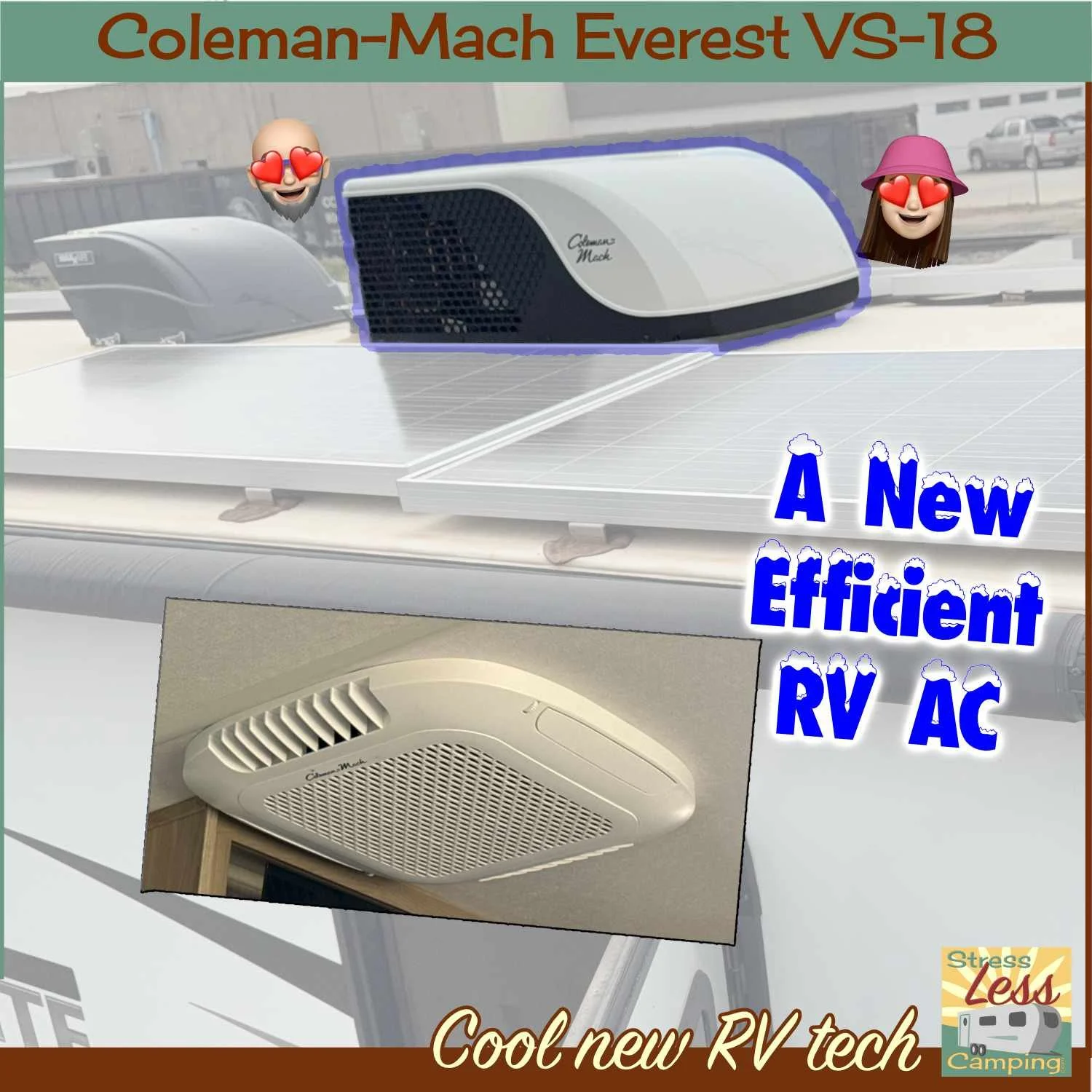
Coleman-Mach Everest VS-18 - a more efficient and quite RV AC
We test a new quiet, powerful and efficient air conditioner for RVs
Today’s RV gadget review is of the new Coleman-Mach Everest VS-18 RV air conditioner. This is a completely new product from Coleman-Mach that takes advantage of the very latest technologies and ideologies in the RV air conditioner world.
What is the Coleman-Mach VS-18
The Coleman-Mach Everest VS-18 RV is an air conditioner designed to fit into any standard RV roof that has the typical 14.5” x 14.5” hole. This has been a standard mounting spot for RV air conditioners since Coleman-Mach invented the category back in 1967.
Just about every major RV air conditioner nowadays fits into this space with RVs being ready for these roof-top air units. There is usually 120vac power run to the hole to power the AC so installing these can be as simple as simply dropping the unit in place and securing it with the included mounting bolts.
Coleman-Mach was the first RV air conditioner company after an employee took a camper equipped with some Coleman gear out. When he returned he loved the trip but said it was just too hot. Thus, the RV air conditioner became the product of this adventure and Coleman has been building them for RVs ever since.
What’s the big deal?
Modern air conditioners have become much more efficient and significantly less power hungry thanks to improvements in motors, compressors and control technologies.
But the demand to improve RV air conditioners from an efficiency standpoint hasn’t been that significant until the Furrion Chill Cube came out showing just what was possible in this space. While there is also the Truma Aventa RV air conditioner and it, too, is really efficient, Furrion’s entry just became a huge hit in the aftermarket as well as with some RV manufacturers.
We have a full review and video of the Furrion Chill Cube.
The Chill Cube really showed the RV industry that there is demand for a much quieter and significantly more efficient RV air conditioning solution. Apparently Coleman-Mach had already been working on the idea but this showed just how much demand there is.
These more modern AC systems work differently in that the compressor slowly ramps up from a start rather than just coming on at full blast. Further, the system stays running at different compressor and fan speeds rather than just turning on and off.
By ramping up the compressor slowly there isn’t the huge surge of energy demand to kick the compressor into action so there isn’t a need for a soft start since the system effectively does this natively.
Also, the system operates at different fan and compressor speeds so the system can reduce energy demand and still provide cool air flow meaning the RV doesn’t have such significant cycles of hot and cold. Instead it’s more even and is absolutely more comfortable.
The new systems are also much quieter. I measured about 53 decibels when the AC was running at a lower speed and as much as 67 decibels at the air conditioner’s highest speed.
Further, Coleman-Mach states that the Everest is good for about 18,000 BTU of cooling power. This compares favorably to the traditional RV AC system which tends to max out at 15,000 BTU with smaller units producing as little as 9,000 BTU.
In our tests on a very warm day the AC was good at keeping the temperature inside our Rockwood Mini Lite 2506FK at a comfortable level even with outside temperatures going into the high 90s.




Running on a generator or battery power
Because there isn’t the huge surge of power demand as the air conditioner ramps up and due to the much more efficient operation while running it’s feasible to run the Everest on a single 2,000 watt generator.
I have also been running the system on my solar and battery system from Mastervolt. Because of the detailed reporting of this system I have been able to create the chart that accompanies this article.
I have a full review of our MasterVolt solar and lithium RV power system here.
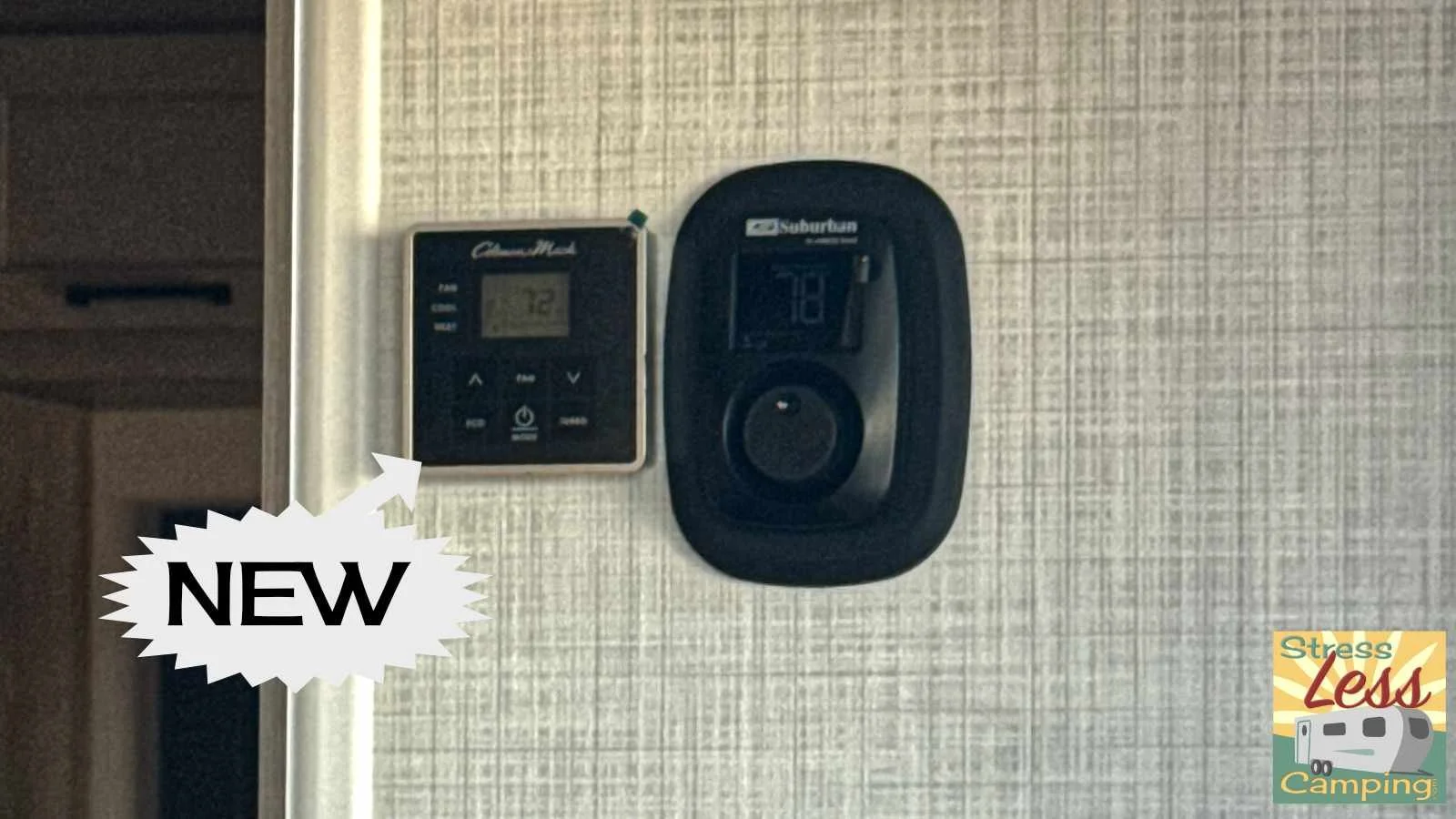
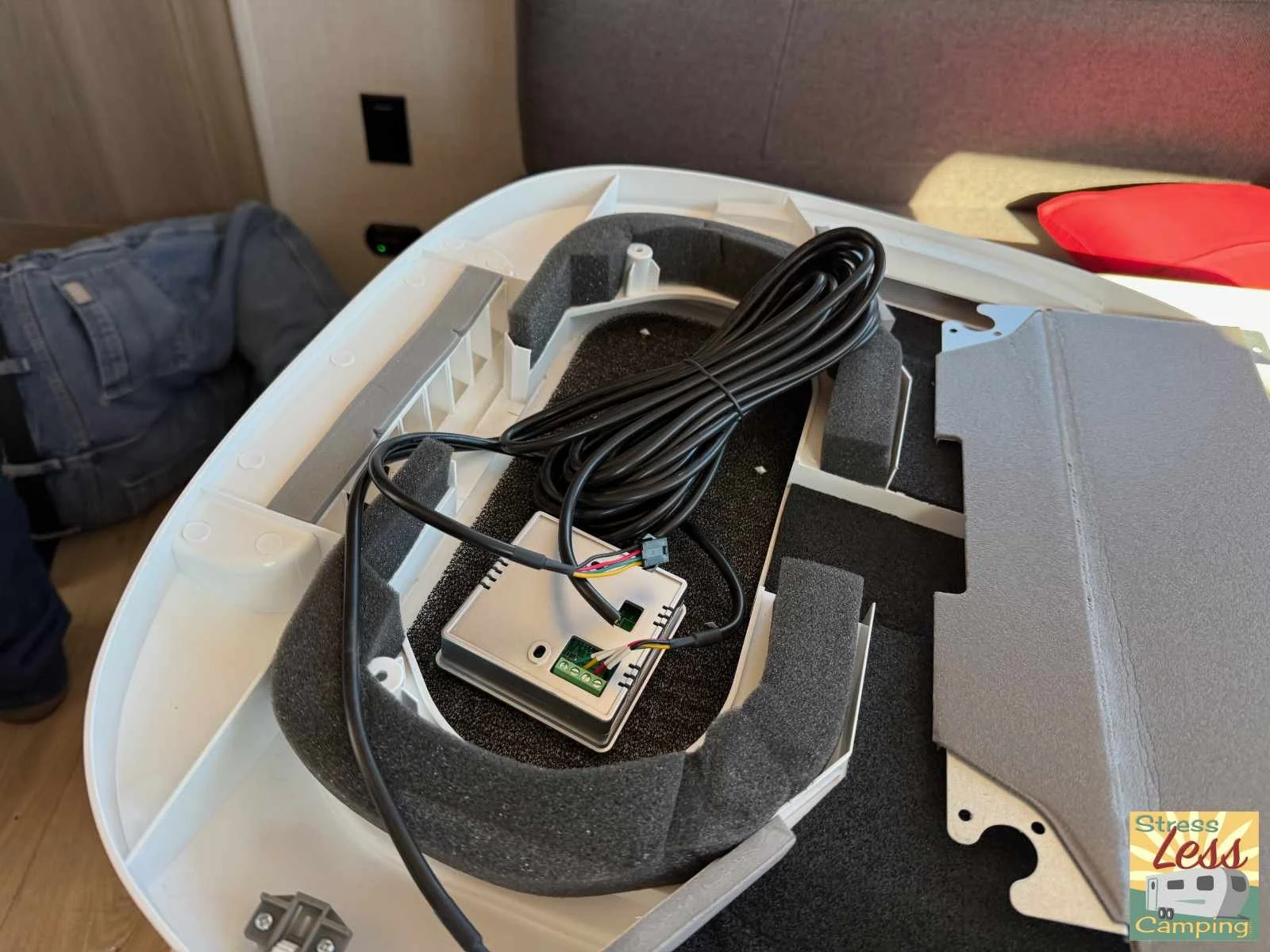
The Coleman-Mach Everest VS-18’s controls, at the moment, include a wall-mounted thermostat that is connected to the roof-mounted unit by wires. This is a digital control system rather than the old analog controls enabling the wall-mounted thermostat to have a few more functions.
There is a wall thermostat coming out that will enable remote control of the unit but this bit of tech hasn’t quite been perfected just yet. But I did see it.
Operating modes of the Coleman-Mach Everest VS-18
If you just want to let the smarts behind this system do the work, simply power it on, set a temperature and grab a beer. Or whatever.
But there are several of different modes worth taking note of in addition to simply leaving the system on auto.
There is a turbo mode that operates the AC unit at maximum performance. This will run the compressor and fan at their highest speeds. But the system still ramps up the compressor and fan so you still won’t need an external soft start.
There is also an eco mode which is great if you’re boondocking or to operate the system overnight. This runs the fan and compressor at a lower speed while still having the system work to maintain temperatures.
Finally there’s a dry mode that works to remove humidity from the air. Quite honestly this is the only mode I wasn’t able to test as we’ve been in New Mexico the whole time we’ve had the Everest and the humidity here is about 9-15%. Interestingly in dry mode the system compares current temperature to the set point and determines whether or not to run the compressor and fan to reduce humidity.
A few more details
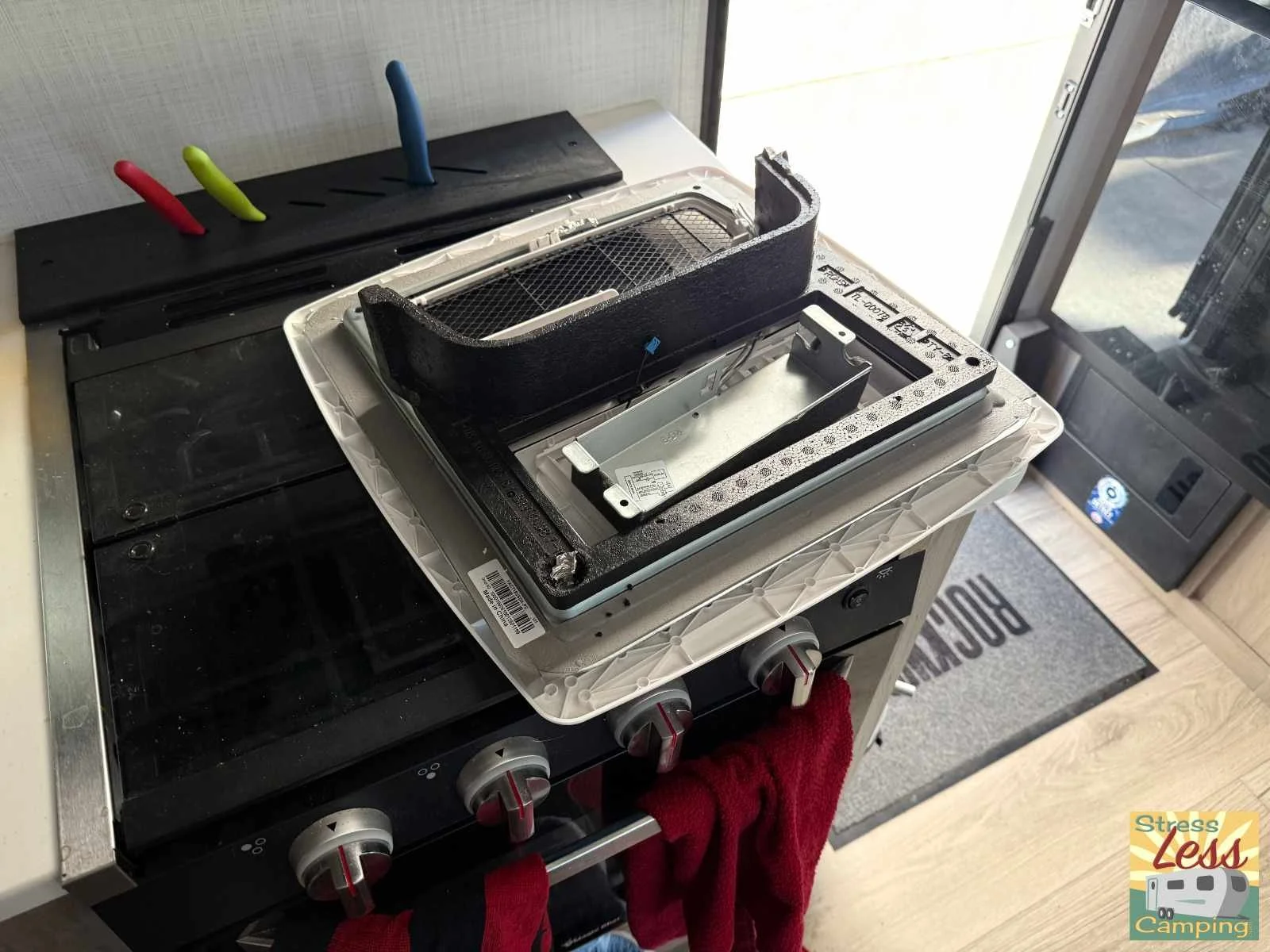
One of the interesting things about the design of this AC system is that the ducted and non-ducted units are essentially the same with a baffle in the unit being the primary difference. So this means that, for the sake of manufacturing and part numbers, there is just one model you have to order. If you have a ducted roof-top AC installation you get the baffle, if you don’t you simply don’t install it.

Our video and audio podcast about the Coleman-Mach Everest VS-18
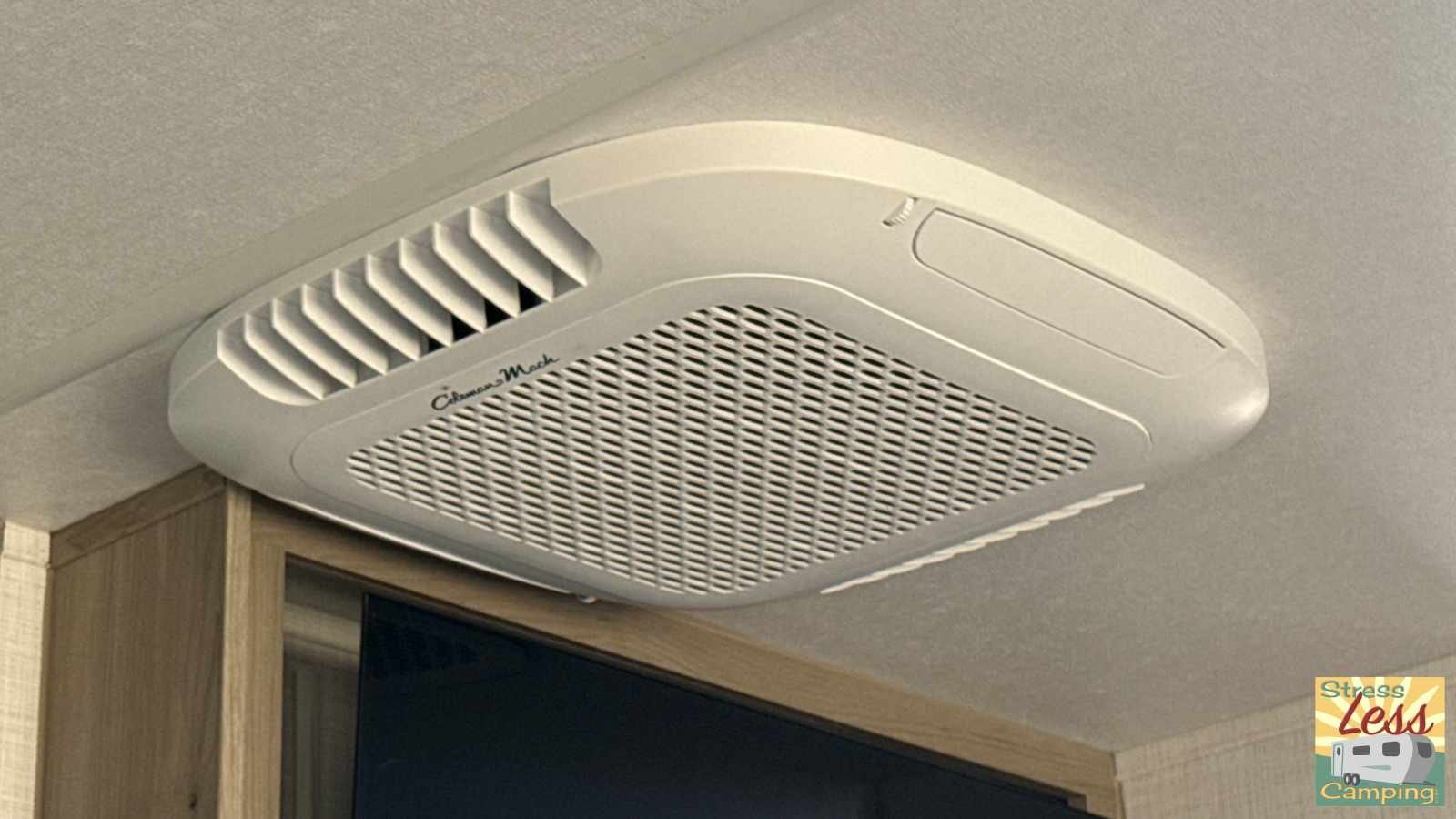
Something I really liked was the filter system on this unit. The interior shroud has one very large air intake on it. Behind this is the filter and this is significantly larger, at least to my eyes, than the typical RV air conditioner filter.
But it also is really well designed. You push up on the air intake and it unlatches the filter enclosure enabling you to drop the door and access the filter.
Why not a mini split?
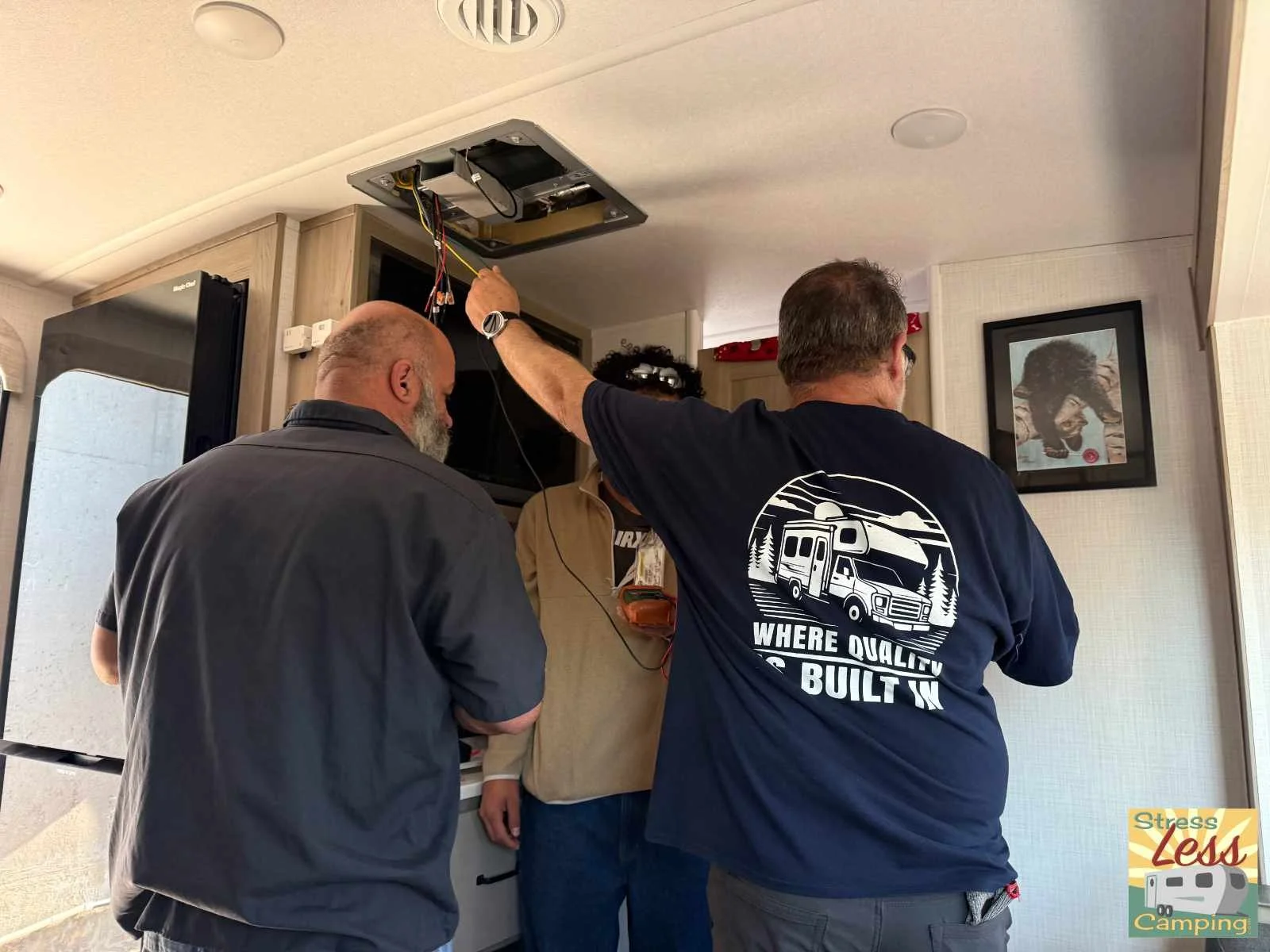
We went to Wichita, Kansas to the home of Coleman-Mach, part of AirXcel, to have them install the new air conditioner and just watch them build air conditioners.
The company does make mini split-style air conditioners that will work in RVs but these are highly uncommon for a few reasons. One of those is that you would need a certified AC specialist to hook the cooling lines inside the RV on the assembly line. But you’d also have to figure out where to run those lines.
Another factor would be you’d have to train RV technicians to repair the system and, likely, the incidence of repair would go up adding this layer of complexity. In other words, the roof-top AC system offers a lot of advantages in the real world of RV air conditioning.
I also asked why RV air conditioners aren’t field-serviceable. They are a packaged, closed system.
Again, the idea of field service was the challenge with accountability for the caliber of the repair being a big issue.
If a repair is made and the system still doesn’t work properly, whose fault is it? It’s simply easier to provide a replacement unit which can also be less expensive depending on the amount of time a technician spends.
What about 12 volt and 48 volt systems?
There are an increasing number of 12 volt and 48 volt systems coming to the market. The advantage of a 12 volt system is that you don’t need an inverter in the RV if you want to run on battery power. But the disadvantage is that you need some significantly fat wiring to run enough power from the battery to the AC at 12 volts.
RVs are almost universally wired with a 120vac power source by the standard 14.5” x 14.5” hole on the roof so changing to something like the Coleman-Mach Everest VS0-18 is a really simple process with the infrastructure already being there.

The Coleman-Mach plant in Wichita is an example of clean and modern manufacturing in the U.S.
Final thoughts on the Coleman-Mach Everest VS-18
There’s a lot to unpack here.
When I was in Wichita I got to see AirXcel’s plant and I have to say it’s immaculate and extremely well run. There are a variety of tests along the line to these systems with units having to pass each test in full before it is allowed to move on. This is honestly the most well run facility I have seen in the RV industry. Period.
The company said their intention is that each unit is able to last at least 10 years and remain within original specification. Of course some units fail, every mechanical system can fail. But the goal is admirable and the processes in place are intended to support that.
Now, while almost all the AC systems from Coleman-Mach are built here in Wichita, the Everest is not at this time. The company is working to bring production to the U.S. but, at the present time, the components to make these aren’t readily available here so the unit is made overseas. This was the same thing Furrion told me about their Chill Cube.
On the subject of the Chill Cube, if I had the choice, which would I rather have?
I would say these two units are pretty comparable in performance. The Coleman-Mach unit does seem to provide much more air flow through the ducts of our Rockwood Mini Lite 2506FK; however, I think the Coleman-Mach unit was installed better than the Chill Cube was in our case.
I like the filter system on the Everest quite a bit and I like that it operates with a wall thermostat and, ultimately, will be able to run with a thermostat that will incorporate a wireless function.
The wireless remote that is part of the Chill Cube is slick; however, it only works within line of site of the Chill Cube. In other words, if you bring the remote into the bedroom of your RV and the remote can’t “see” the main unit, the communication is lost so the “follow me” functionality is essentially lost.
If your RV is equipped with either unit I can see no reason to want to swap to the other. We only did it so I could share these numbers with you.
I did get a more inside look at how Coleman-Mach does things and met the team that do the things and they’re very confidence-inspiring. The test lab and the people are top notch. I’m not saying Furrion’s are not, I didn’t get access to that part of the company.
The nice thing about these newer air conditioners is that they’re designed to work in the reality that RVs travel in. If we see wider adoption of these far more efficient units across the board, which I hope we do, there will be fewer issues with RV parks not able to provide sufficient power on hotter days.
And, if the power does go out and you have a decent battery system, that could also operate your AC if the power does go out.
Overall this new Coleman-Mach Everest VS-18 is a solid piece of equipment that will make a real-world difference to many RVers. Even if you don’t camp where you need to provide your own power, this unit is quiet and performs well.
If I were buying a new RV today I wouldn’t buy it without either this Coleman-mach Everest VS-18 or the Chill Cube. There’s nothing that older RV AC designs can do that these can’t do better in every way.
Talk about cool - our resources for RVers bring it